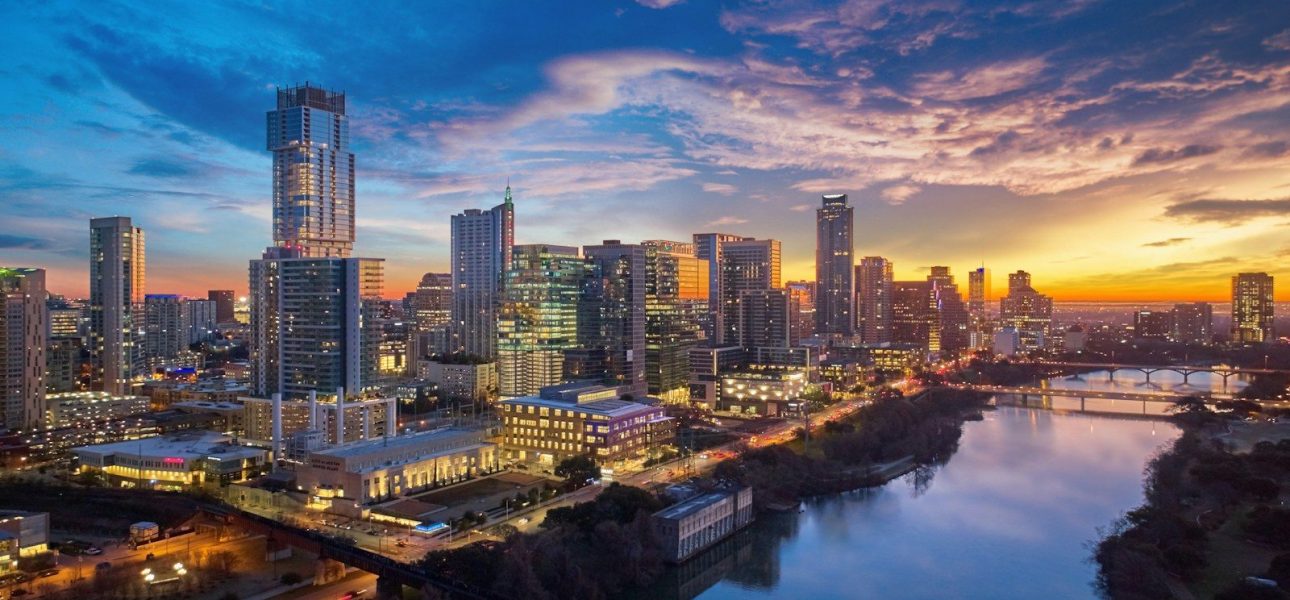
If you are allocating real estate capital anywhere in the United States right now and you are not paying close attention to what is happening inside the Texas Triangle, you are working with an incomplete map. The geographic region bounded by Dallas-Fort Worth, Houston, Austin, and San Antonio has crossed a threshold that goes well beyond typical Sun Belt growth narrative. This is not a story about migration and affordability. It is a story about the systematic transfer of corporate headquarters, technology infrastructure, talent, and capital from coastal markets to the interior of America, and the Texas Triangle is where that transfer is concentrating.
The numbers are striking. More than 200 corporate headquarters relocated to Texas between 2020 and mid-2025. That list includes Oracle, Tesla, Hewlett Packard Enterprise, Charles Schwab, CBRE, and dozens of others representing over two trillion dollars in combined market capitalization and more than 230 billion dollars in annual revenue. Dallas-Fort Worth alone crossed 100 corporate headquarters relocations since 2018, the most of any American city by a significant margin. And the pattern is self-reinforcing: companies follow talent, talent follows companies, infrastructure follows both, and real estate demand follows all of it.
Understanding why this is happening with the depth required to invest intelligently against it requires going beyond the headline numbers. The mechanisms driving corporate relocation to Texas are structural, not cyclical, which means the real estate demand they generate is durable rather than temporary.
Why the Corporate Migration Is Structural, Not Cyclical
The primary driver of corporate relocation to Texas is cost arbitrage, but calling it simply a tax story understates the complexity of what is happening. Texas offers no state income tax, but so do several other states that are not capturing anywhere near the same volume of relocations. The tax advantage is a necessary but not sufficient condition. What makes Texas uniquely compelling is the combination of the tax environment with available land, lower construction costs, a diversified talent pool, and a regulatory and permitting environment that allows companies and developers to execute faster and with more certainty than in coastal markets.
California is doing Texas’s recruiting, as one analyst put it. High taxes, regulatory burden, and cost pressures are pushing companies out of San Francisco, San Jose, and Los Angeles, and those outbound flows map almost directly onto inbound gains in DFW and Austin. The donor-recipient dynamic is deeply established and shows no sign of reversing. Every company that relocates creates a demonstration effect for others in its industry network who are watching the move and evaluating their own position. The network effects of corporate clustering are well understood from the Silicon Valley experience, and the same dynamics are now operating in the Texas Triangle in the opposite direction.
The data center infrastructure buildout adds another structural layer that coastal markets simply cannot replicate. Texas leads the nation in commercial construction spending at nearly 90 billion dollars annually, more than double any other state. Data center vacancy in Texas is virtually zero, and the Austin to San Antonio corridor alone has 7,823 megawatts of planned capacity against only 1,154 megawatts currently operating. These are not temporary installations. They are multi-decade infrastructure commitments that create permanent demand for surrounding land, workforce housing, and commercial services.
The Four Nodes and What Each One Means for Real Estate
The Texas Triangle is not a monolithic market. Each of the four anchor cities has distinct economic drivers, demographic profiles, and real estate characteristics that require differentiated investment approaches. Understanding those differences is what separates investors who capture the full opportunity from those who apply a single strategy across a market that rewards specificity.
Dallas-Fort Worth is the headquarters relocation capital of America and the most diversified economy in the Triangle. The DFW metro has benefited disproportionately from financial services relocations, technology company moves, and corporate back-office consolidations. Multifamily demand in DFW is driven by white-collar relocation at the higher income tiers, creating strong demand for Class A workforce housing in the suburban corridors. Rent growth of 4.9 percent year-over-year as of mid-2025 and absorption that is finally outpacing deliveries after a supply-heavy period make DFW the most stabilized of the four metros for multifamily investors entering now.
Houston retains its energy sector dominance but has diversified into healthcare, professional services, and now technology as the city captures spillover from the broader Texas boom. The Port of Houston and the energy infrastructure make industrial real estate particularly compelling, while multifamily in the inner loop and select suburban corridors offers value add opportunities in aging stock that is well positioned to benefit from ongoing employment growth. Houston’s commercial real estate market is still healing from office vacancy challenges, but industrial and retail are performing strongly.
Austin captured the technology sector core of the corporate migration wave, absorbing Tesla’s headquarters and the significant tech employer ecosystem that followed. The multifamily market in Austin overbuilt significantly between 2021 and 2024, which has created a temporary vacancy challenge but simultaneously creates an acquisition opportunity for investors who can identify assets trading below replacement cost with strong long-term fundamentals. The data center corridor from Austin south through Williamson County and toward San Antonio is where some of the most significant infrastructure investment in American history is being concentrated.
San Antonio is the most underrated market in the Triangle for investors who prioritize affordability, stability, and relative scarcity of institutional competition. Rents are lower than the other metros, but so are acquisition costs, and the fundamentals are sound: military employment through Joint Base San Antonio, a growing healthcare and cybersecurity sector, strong tourism revenue, and population growth that is consistent if not as dramatic as Austin’s peak years. Retail vacancy in San Antonio runs between 3 and 5 percent, which is among the tightest in the country.
The Suburban and Exurban Corridors as the Real Opportunity
The most explosive population growth in the Texas Triangle is not happening in the urban cores. It is happening in the suburban and exurban counties connecting the four anchor metros. Hays County between Austin and San Antonio, Williamson County north of Austin, Comal County between San Antonio and Austin, and the northern DFW suburbs including Collin and Denton Counties are consistently ranking among the fastest-growing counties in the entire country. The Austin to San Antonio corridor is projected to reach nearly 7 million people by 2030.
This suburban rooftop growth is the primary engine for new commercial real estate demand. Every new household requires grocery stores, medical offices, local service providers, restaurants, and the retail infrastructure of daily life. In markets where that infrastructure does not yet exist at the scale population growth demands, neighborhood-serving retail and mixed-use development opportunities are abundant. In markets where it exists but is aging, value add repositioning is the play. In markets where the corridor is just beginning its growth cycle, ground-up development backed by private bridge financing is where the most significant long-term value is being created.
The investor who maps the Texas Triangle with county-level demographic granularity, overlays corporate relocation data with commuter pattern analysis, and identifies the specific corridors where population growth is outpacing commercial real estate supply will find a decade of compelling deals ahead. The capital required to execute those deals is available through private lenders who understand the Texas market, and the Bancaverse network includes over 150 lenders with active programs across every Texas market and every commercial real estate product type.
Financing the Texas Triangle Opportunity
The structural shift in American corporate geography is creating a real estate opportunity of unusual duration and depth. But opportunity without capital is just observation. The financing environment for Texas commercial real estate in 2026 is more selective than it was during the peak years, which means the investors who access private capital efficiently through curated lender networks will have a meaningful advantage over those who rely on the conventional financing system that has consistently underserved commercial real estate investors throughout the current rate cycle.
Private bridge lending for Texas multifamily and commercial acquisitions is available at rates between 9 and 13 percent depending on asset type, borrower experience, and loan-to-cost. DSCR permanent financing for stabilized Texas assets runs between 7.25 and 9.5 percent. Construction lending for ground-up projects in high-demand corridors is available from lenders who understand the Texas market and can close within two weeks on clean files. The deals that get funded fastest in this environment are the ones submitted with complete packages, honest numbers, and exit strategies grounded in the actual market dynamics described in this guide. That preparation, combined with access to the right capital, is the complete formula for capturing what the Texas Triangle is offering in 2026 and the years ahead.
Financing the Texas Triangle Opportunity
The structural shift in American corporate geography is creating a real estate opportunity of unusual duration and depth. But opportunity without capital is just observation. The financing environment for Texas commercial real estate in 2026 is more selective than it was during the peak years, which means the investors who access private capital efficiently through curated lender networks will have a meaningful advantage over those who rely on the conventional financing system that has consistently underserved commercial real estate investors throughout the current rate cycle.
Private bridge lending for Texas multifamily and commercial acquisitions is available at rates between 9 and 13 percent depending on asset type, borrower experience, and loan-to-cost. DSCR permanent financing for stabilized Texas assets runs between 7.25 and 9.5 percent. Construction lending for ground-up projects in high-demand corridors is available from lenders who understand the Texas market and can close within two weeks on clean files. The deals that get funded fastest in this environment are the ones submitted with complete packages, honest numbers, and exit strategies grounded in the actual market dynamics described in this guide.
More than half of Texas labor force growth in a typical year comes from migration from other states or countries, according to the Dallas Federal Reserve. That migration pipeline is not a 12-month trend. It is a 30-year demographic and economic transition that has made the Texas Triangle the fastest-growing major regional economy in America. Investors who understand that timeline and build their capital allocation strategy around it, rather than around quarterly data fluctuations, will find that the Texas Triangle rewards patience, preparation, and systematic execution in ways that very few real estate markets in the country can match in the decade ahead.
Opportunity Zones Overlapping the Texas Triangle Growth Corridors
One additional dimension of the Texas Triangle opportunity that deserves specific attention is the overlap between high-growth corridors and Opportunity Zone designation. Texas has 628 currently designated Opportunity Zones, with approximately 605 new designations expected under OZ 2.0 taking effect January 1, 2027. Several of the fastest-growing Texas Triangle corridors have census tracts that meet OZ eligibility criteria, creating a situation where population growth, employment demand, and tax-advantaged investment incentives all point to the same geography.
The combination of genuine economic momentum and OZ tax benefits is more powerful than either factor alone. An investment in a Texas Triangle OZ-eligible corridor that generates 15 percent annualized appreciation over a 10-year hold produces a dramatically different after-tax return than the same investment outside an OZ, because the appreciation on the OZ investment itself is permanently excluded from taxable income if held for the required period. For investors with eligible capital gains to deploy, the Texas Triangle OZ opportunity represents one of the most tax-efficient wealth-building vehicles available in American real estate today.
The preparation required to capture this opportunity begins now, before the new OZ designations are finalized, before the acquisition market prices in the OZ premium, and before the institutional capital that will follow the designation announcement arrives to compete for the best assets. Working with a private lending partner who understands the Texas market and can close quickly on the right acquisitions is the operational requirement that translates this strategic analysis into actual deployed capital and actual returns. The Texas Triangle rewards investors who combine strategic market knowledge with the operational discipline to execute quickly and the financing relationships that make speed possible. Position now, prepare thoroughly, and the opportunity will deliver.
Get Multiple Offers on Your Deal
Texas Triangle Real Estate Market 2026: Key Takeaways
When it comes to Texas Triangle real estate market 2026, a few fundamentals drive the outcome. However, markets shift, so timing, leverage, and structure all matter. As a result, lining up the right financing early is often the difference between a deal that closes and one that stalls.
Bancaverse helps real estate investors with Texas Triangle real estate market 2026 — we structure the scenario and match it to the private lenders most likely to fund it. Explore our commercial real estate financing and the full loan products overview, or browse our FAQs. Ready to move? Get matched with a lender →