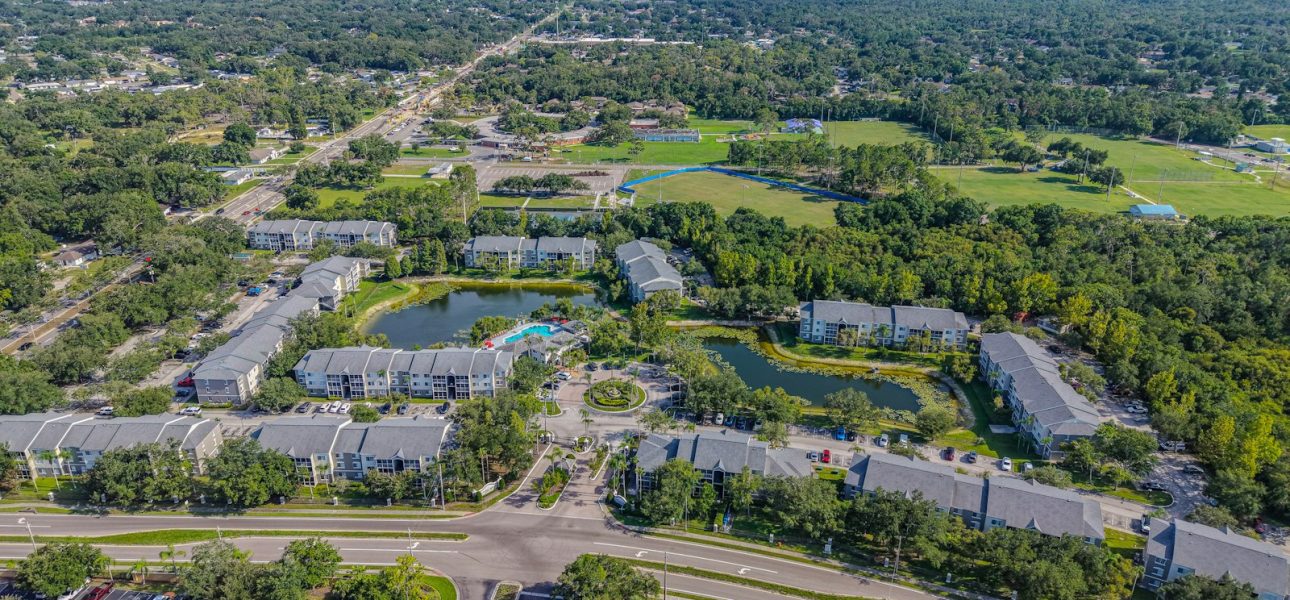
Quick answer: Atlanta’s new apartment supply is easing after a record delivery wave, while rents are roughly flat and vacancy remains elevated, which makes the market a selective opportunity for value-add sponsors who can buy at a basis that supports renovation and lease-up. A multifamily bridge loan funds the acquisition and the renovation budget so a sponsor can reposition the property and then refinance into longer-term debt.
Key takeaways
- Two published Q3 2026 market reports show Atlanta apartment completions falling sharply from the 2024 peak, which reduces competition for lease-up over the next business-plan period.
- The same reports show rents roughly flat and vacancy still elevated, so a plan should rely on operational improvement and basis, not on market rent growth.
- Fulton, Gwinnett and Cobb counties each have different tenant bases, and renovation scopes and rent targets should be built submarket by submarket.
- A bridge loan is a transition tool; the business plan should name the takeout source and test it against a conservative case.
What is happening to Atlanta apartment supply?
Atlanta absorbed one of the largest waves of new apartment construction in the country, and the data now point to a slowdown in what is being delivered. Matthews’ Atlanta multifamily report for the third quarter of 2026 says trailing twelve-month completions were down 43% versus the prior trailing twelve-month period, and that annual completions peaked at 24,443 units in 2024, as reported on the Matthews Atlanta multifamily market report. The same report notes that trailing twelve-month absorption was also lower than a year earlier, which is a reminder that demand has not simply replaced supply.
Lee & Associates, using a different methodology, reports Atlanta vacancy of 10.50% in the third quarter of 2026 compared with 11.20% a year earlier, asking rent of $1,652 per unit versus $1,646, and a decline of roughly 16% in units under construction, according to its Q3 2026 Atlanta multifamily market overview. The two reports measure vacancy differently and should not be blended into one figure, but they agree on the direction of supply: new construction is slowing.
We read this honestly. It is not a story of fast rent growth. Rents are roughly flat, vacancy is elevated by Lee’s measure, and a sponsor who underwrites aggressive rent increases is taking a risk the data do not support. It is, however, a story of stabilization. As fewer new buildings compete for tenants, a well-run, renovated older property can have a clearer path to leasing, and a buyer who acquires at a sensible basis may find motivated sellers who financed at the top of the cycle.
Bancaverse is a private credit platform and brokerage. We arrange multifamily bridge loans from capital partners and we do not lend from our own balance sheet.
How does a multifamily bridge loan fit an Atlanta value-add plan?
A value-add business plan buys a property where income can be improved through renovation, better management or lease-up, then refinances once the improvements are in place. Banks and agency lenders often prefer stabilized properties, so a sponsor who needs to renovate or lease up may use a bridge loan during the transition. The bridge loan typically funds the acquisition and holds back a renovation budget that is released as work is completed.
The structure usually includes a term of one to three years with extension options, interest-only payments and an interest or operating reserve, although the specifics depend on the capital partner and the deal. We cannot quote terms here and terms vary by property and sponsor. What we can say is that capital partners focus on three questions: what is the basis, what will the renovation accomplish and how will the loan be repaid.
If you are comparing Atlanta with other states, our pillar guide to multifamily bridge loans in Texas, Tennessee, Kentucky and Georgia explains the basic framework, and our article on multifamily bridge loans in Ohio as rent growth cools shows how a similar story plays out in the Midwest.
How do Fulton, Gwinnett and Cobb counties differ?
Metro Atlanta is not a single market. A sponsor’s plan should name the submarket and explain why the property will lease at the target rent. The table below summarizes the diligence questions that tend to matter, and it is a framework and not a forecast.
| Question | Fulton County | Gwinnett County | Cobb County |
|---|---|---|---|
| Typical tenant base | Urban professionals, students and workers near employment centers, with large differences between the city core and outlying areas | Suburban households, a diverse and family-oriented tenant base | Suburban workers near the Cumberland, Smyrna and Marietta job centers |
| Common value-add profile | Older garden and mid-rise assets, interior upgrades and amenity repositioning | 1980s-1990s garden communities with dated interiors | Older garden communities near major corridors |
| Key diligence | Submarket rent comps and neighborhood momentum | Competing new supply nearby and renovation premium evidence | Commute patterns and employer proximity |
| Underwriting focus | Basis and exit refinance feasibility | Renovation scope and lease-up pace | In-place occupancy and expense control |
What should a conservative Atlanta business plan include?
Start with the in-place rent roll and the trailing twelve-month operating statement, and normalize them. Identify what you will change. Interior renovations, exterior and curb-appeal work, utility billing, amenity upgrades and tighter expense control can each add value, but each needs evidence, such as a comparable renovated property that is actually achieving the rent premium you project.
Then build the downside. Because published data show rents roughly flat and vacancy still elevated, a good plan tests what happens if rents do not rise, if lease-up takes longer than planned or if concessions are needed. Ask how much cash flow remains, how long the interest reserve lasts and what you will do if the takeout lender wants higher occupancy than you have reached by the maturity date. A plan that survives those questions is more likely to survive a capital partner’s credit review.
Remember too that expenses matter as much as rents. Property taxes, insurance and payroll can move independently of rents, and an apartment owner who controls expenses can protect net operating income even when rent growth is slow.
Reviewing an Atlanta apartment acquisition? Send us the rent roll, the operating statements, your renovation budget and your takeout plan, and we will tell you how capital partners are likely to view the file. Schedule a call or start an application.
What takeout options should you plan for?
A bridge loan is repaid by a sale or a refinance. Typical takeout sources for stabilized apartments include agency lenders, banks, life companies and debt funds, each with its own occupancy, debt service coverage and sponsor requirements. Plan for the takeout from the first day. Ask what occupancy and net operating income a permanent lender would need, calculate whether your business plan reaches it before maturity and keep a margin for error.
Interest-rate and refinance conditions change, so do not assume the takeout environment at closing will be the same at maturity. Our Texas guide to the 2026 CRE maturity wall and refinance playbook explains why sponsors who prepare multiple exit routes are better positioned when conditions shift.
Should an Atlanta sponsor use a bank or private credit?
It depends on the property and the timeline. A bank may be a good choice for a stabilized property and a strong existing relationship. Private credit is often better suited to a transitional property, a fast closing or a structure with future funding for renovations. Many sponsors use both at different stages of the same investment. Our comparison of private credit and bank loans for Georgia commercial real estate looks at that decision in detail, and our guide to spec industrial construction loans in the Savannah port corridor shows how another part of the Georgia economy is financed.
What documents do capital partners expect?
A complete package usually includes the purchase and sale agreement, a current rent roll and twelve months of operating statements, a property condition report, a renovation budget with a contractor bid or scope, a business plan with a pro forma and a downside case, sponsor financial statements and a track record of similar properties, and an entity chart. If the property is in a flood zone or has deferred maintenance, include the documentation up front. A well-organized file shortens the review. Terms and availability vary by sponsor, property and capital partner.
Frequently asked questions
Are Atlanta apartment rents rising?
Published Q3 2026 data show asking rents roughly flat year over year, so a business plan should not assume market rent growth. Gains are more likely to come from renovation, management and expense control.
Is Atlanta still oversupplied?
Completions have fallen from the 2024 peak and the pipeline is smaller, but one report shows vacancy still elevated. Submarkets differ, so underwrite property by property.
What is a multifamily bridge loan?
A short-term loan that funds the acquisition and renovation of a transitional apartment property, designed to be repaid by a refinance or a sale once the property is stabilized.
How long does a bridge loan last?
Terms vary by lender and deal and often include extension options. Review the maturity, extension conditions and prepayment terms before you close.
Can Bancaverse promise approval or a specific loan amount?
No. Bancaverse arranges financing from capital partners, and terms depend on the property, the sponsor and the lender.
Does Bancaverse lend its own money?
No. Bancaverse is a private credit platform and brokerage that arranges financing from capital partners.
References
- Matthews: Atlanta, GA Multifamily Market Report, Q3 2026
- Lee & Associates: Q3 2026 Atlanta, GA Multifamily Market Overview
This article is educational, not legal, tax or investment advice. Market data from third-party sources use different methodologies and can change. Terms and availability vary by property, sponsor and capital partner.
Bancaverse can help you get private capital for your commercial real estate project.